Math/Logic
Murdle
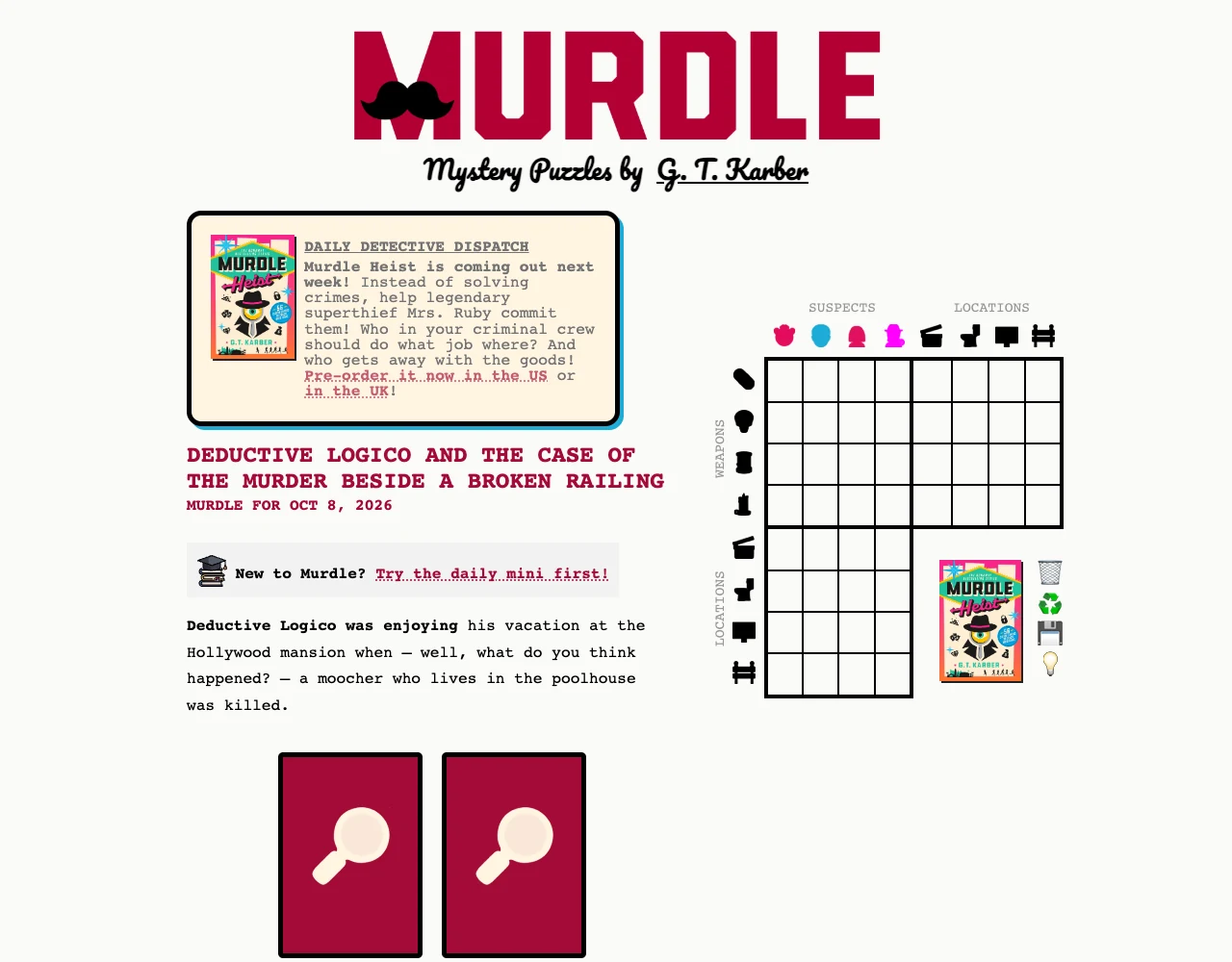
Read a daily murder mystery, connect suspects with weapons and locations, and use a deduction grid to identify the culprit.
Browse other categories · All games
Read a daily murder mystery, connect suspects with weapons and locations, and use a deduction grid to identify the culprit.
Try another search or turn off the favorites filter.
Math and logic puzzles ask you to work toward an answer that satisfies a set of conditions. The subject might involve numbers or relationships, but the shared appeal is a conclusion you can explain. A possibility that fits one clue is not enough if it contradicts another.
In a deduction grid, an impossible pairing can be as useful as a confirmed one. Mark what a clue establishes, then look for consequences across the remaining relationships. Murdle gives this reasoning a mystery setting, connecting suspects, weapons and locations rather than asking you to estimate a quantity.
Revisit the conditions before adding a guess. Check whether two clues can be combined, whether an exclusion has consequences elsewhere, or whether you accidentally treated an assumption as a fact. If you explore a hypothetical answer, keep it distinct from confirmed conclusions until it survives the other constraints.
Not by default. A relationship puzzle can depend on reading and elimination rather than calculation; the category name does not mean every entry uses equations. Check the individual format, and before submitting an answer, test the complete solution against the clues rather than stopping at the first part that looks convincing.