Observation · DAILY GAME
Hexcodle
Read a target colour, then narrow down its six-digit hex code with directional feedback in five guesses.
Added to Everydle ·
Play Hexcodle
PLAY HEREThe game below is hosted by its creator. Its own cookies, controls and privacy settings apply.
What is Hexcodle?
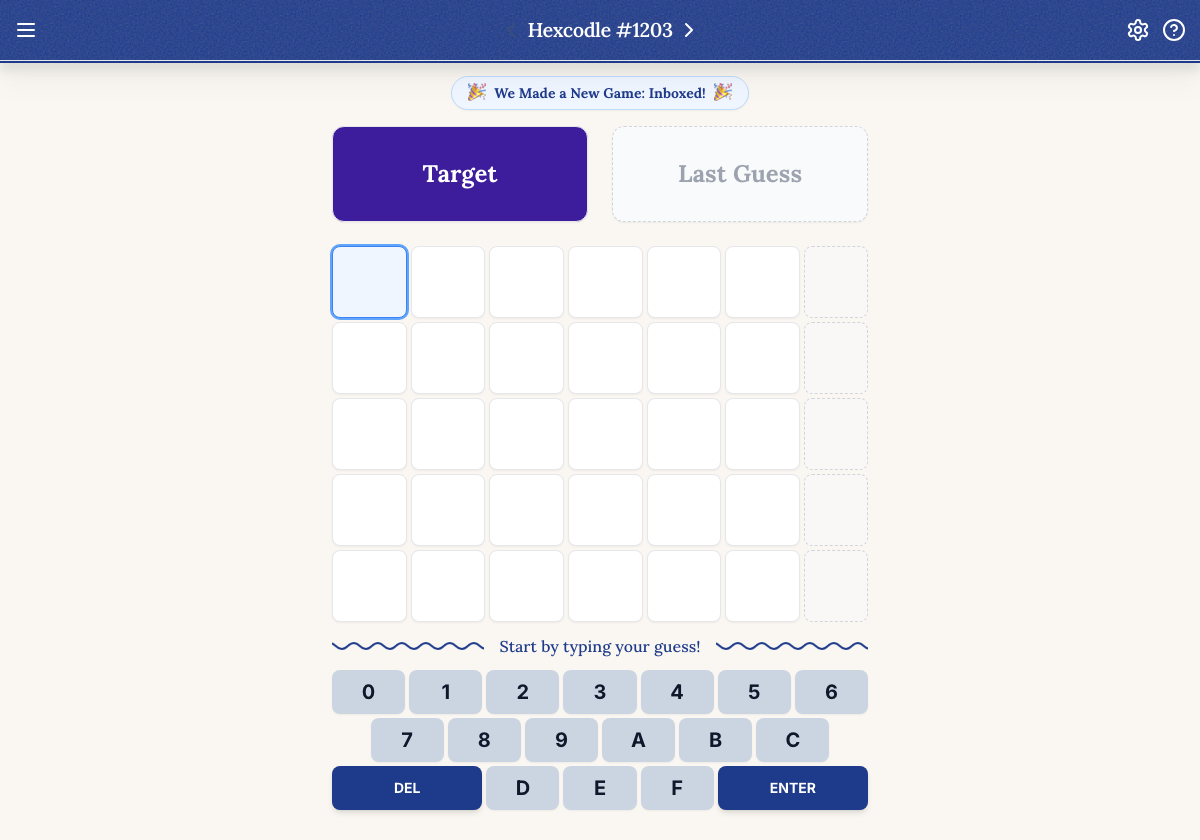
Hexcodle turns a colour swatch into a daily code puzzle. You have five attempts to identify its six hexadecimal digits, using numbers from 0 to 9 and letters from A to F. Each submission gives position-by-position feedback, so your next choice can combine what you see with what the arrows tell you. The current daily board is available directly in the browser without an account or payment screen.
How to play
- Look at the Target colour on the daily Hexcodle board.
- Enter a six-character hex code using 0–9 and A–F, then press Enter.
- Read each position's feedback: a checkmark is an exact match, and arrows point toward a higher or lower target value.
- Use a single arrow for a target one or two steps away, and a double arrow for a target at least three steps away.
- Adjust the code and try to find the target within five guesses.
What do the six digits describe?
A hex colour code is grouped as RRGGBB: two characters control red, two green and two blue. The allowed characters run from 0 to 9 and then A to F. Thinking in those pairs gives your first visual estimate a useful shape, even if you do not memorise colour codes.
How should you read the arrows?
In the default hex mode, arrows point toward the target value at that position. One arrow means you are one or two steps away; two arrows mean at least three steps away. A checkmark fixes a digit exactly. Use the direction as well as the distance clue rather than changing every character at random.
Is Hexcodle Mini the same puzzle?
No. The official navigation separates Hexcodle and Hexcodle Mini, with their own daily pages and archives. This page links to the full six-digit game. The rules also describe optional RGB and difficulty settings, but the instructions here explain the initial hex-code mode.